
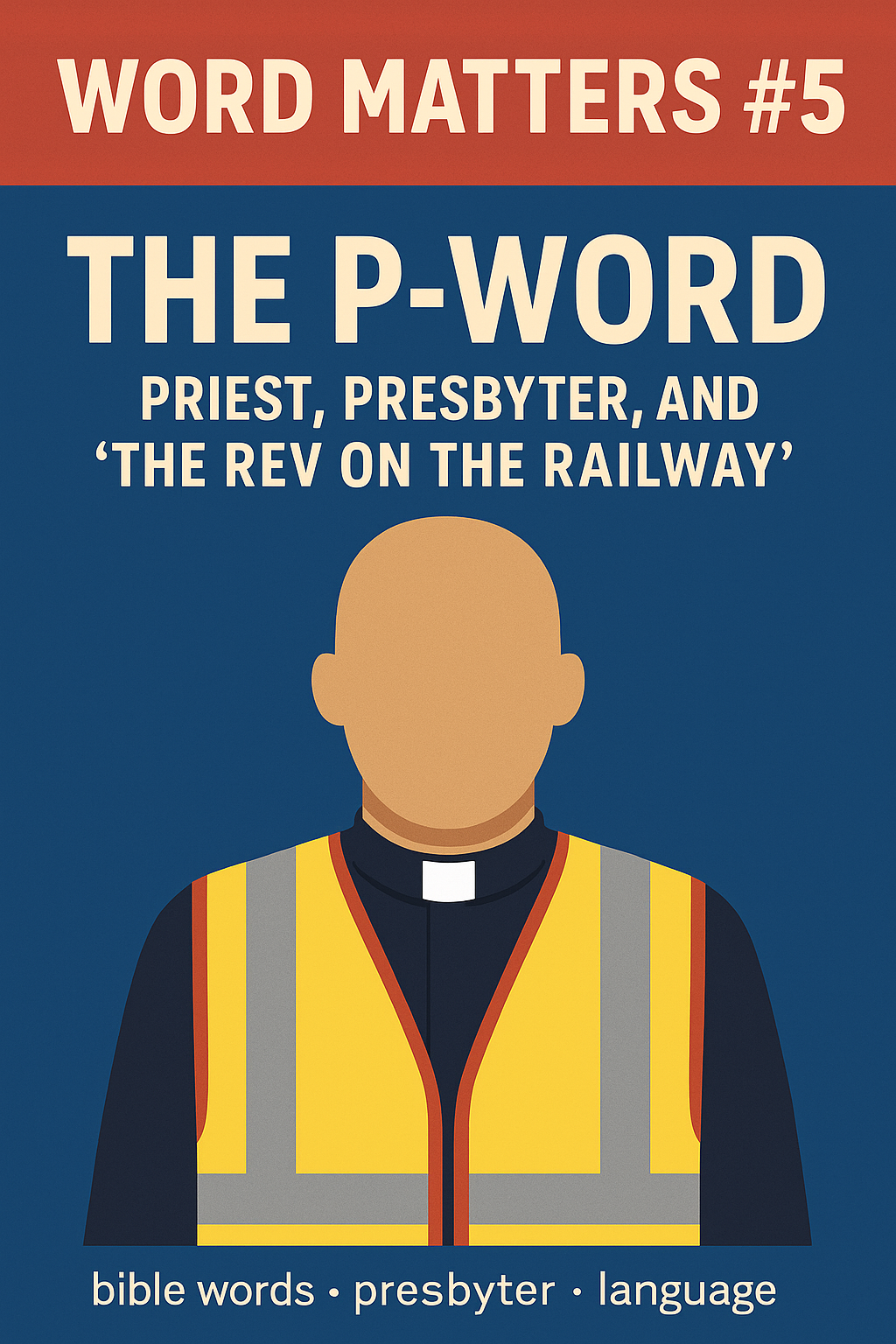
On the railway, nicknames are forever.
You get tagged early and it sticks: something you did, something you stuffed up, or some quirk of who you are. It is almost ontological. You roll up as Dave; you retire as Bluey.
My nickname is “The Rev.”
It is short for Reverend, because as well as being a train driver I am an ordained Anglican priest. The P-word is baked into my story. My licence from the Archbishop says it, the bishop said it, the ordinal says it.
Out in the wild – in depots, pubs, group chats – I still say, “Yes, I am a priest.” People get that straight away.
But every so often a Protestant once-upon-a-time churchgoing background kicks in and someone asks:
“Hang on… are you a pastor, or a minister, or a priest? I thought only Catholics were priests.”
I initially answer, “Yes!” Because that is the correct answer.
But so as not to be difficult or present stumbling blocks, my stock answer continues something like this:
“What you are thinking of is true — only Catholics are that kind of priest. I am the proper kind of priest. I am also a pastor; I am still a minister; I am still a reverend. And underneath all that, ‘priest’ just means I was the designated elder of a church – in role, not in age, despite my children thinking I am older than Moses.”
That last bit is the key.
Because in English, “priest” has ended up doing double duty. It carries both:
the Old Testament sacrificial sense — someone at an altar mediating between God and people the New Testament presbyter sense — an elder who leads, teaches, pastors
I was ordained as the second kind, not the first.
And note that that’s the second kind as I’ve listed them. In reality, it’s the primary kind.
Which is why, later on, some Sydney Anglican paperwork started quietly swapping “priest” for “presbyter”. Same bloke, same ministry, different label.
Which raises the question:
Am I really a priest, or just an elder with a confusing job title?
Three Bible words and one English blur
Old Testament priest: כֹּהֵן — kohen
Hebrew uses kohen (“priest / temple priest”) for the Aaronic, sacrificial priesthood — the sons of Aaron who offer sacrifices, bless the people, and serve in the tabernacle and temple.
A kohen is:
set apart bound to altar, sacrifice, blessing hereditary — you’re born into it
When your Old Testament says “priest,” it is almost always kohen.
New Testament priest: ἱερεύς — hiereus
Greek has its own sacrificial word: hiereus (“priest / sacrificer”).
In the NT it refers to:
Jewish priests in the temple pagan priests Jesus as our great high priest the whole church as a priestly people
But notice what is missing:
Local church leaders are never called hiereis.
New Testament elder: πρεσβύτερος — presbyteros
Originally simply “older man,” presbyteros becomes a title:
elders in Jerusalem elders Titus must appoint elders who lead and shepherd
They:
teach guard pastor oversee (interchangeable with episkopos / bishop)
Crucial point:
Presbyteros is never the sacrificial priest word. Different role, different vocabulary.
How we got the P-word in English
Historically:
presbyteros → presbyter → preost → priest
So “priest” is originally the English descendant of presbyteros, not of kohen or hiereus.
But over time, Western Christianity blurred the roles. The presbyter at the Lord’s Supper came to be seen as a sacrificial officiant at an altar.
The English word “priest” absorbed this.
Now we’ve got three layers tangled:
OT sacrificial priest (kohen / hiereus) NT elder (presbyteros) English “priest” (from presbyteros, sounding like hiereus)
That’s the linguistic mess Sydney Anglicans try to untangle with “presbyter.”
Sydney’s ‘presbyter’ move
Evangelical Anglicans, especially in Sydney, dislike the P-word because it:
sounds like OT priesthood implies mediatory sacrifice risks undermining Christ’s finished work
So they push:
“Same ministry, different badge. Let’s say presbyter.”
Clergy are elders — not mini-Levites.
So what am I? Priest, presbyter, or just The Rev?
Theologically
Cranmer’s ordinal used “priest” as the English translation of presbyteros.
I was made a presbyter — a minister set apart to preach, pastor, and administer the sacraments.
Not a Levite. Not a micro-Christ.
Biblically
The role matches presbyteros / episkopos — elder/overseer.
Ontologically
Still Glenn. No metaphysical switch was flipped.
Functionally
“Priest” helps or confuses depending on the audience.
Which is why my railway explanation lands like this:
“I’m the proper kind of priest — the Bible kind. Think pastor or elder, not Catholic father at an altar. The fancy word is presbyter. ‘Priest’ is just the old English way of saying it that went feral.”
Why the P-word fights actually matter
The gospel is what’s at stake.
If you lean into priest = sacrificial mediator:
you teach people they need a human middleman you blur Christ’s finished work you drift toward altars and repeated sacrifices
If you flatten presbyter into “team leader”:
you lose the weight of ordained ministry you weaken shepherding, guarding, rebuking the church becomes a TED-talk collective
The sweet spot:
Big Christology, modest clergy.
Christ alone is the saving priest (hiereus).
All believers share the general priesthood.
Local leaders are presbyters who preach, pastor, guard.
Cue my dream translation scheme:
restore “priest” to presbyteros invent coheni for sacrificial priests
Which is why I’ll never be put in charge of Bible translations.
One line to keep in your back pocket
Here’s my pub-counter summary:
In the Bible, Christ alone is the real priest who brings us to God. All Christians share a priesthood in him. Blokes like me are really presbyters — elders who preach and pastor. So if you call me “priest,” hear it in that older English sense, not as a man at an altar topping up your forgiveness.
On the roster I am The Rev.
On paper I am priest and presbyter.
But the only P-word that finally matters is the perfect priest who sat down because the job was finished.
And that is not me.
But it is why words matter.